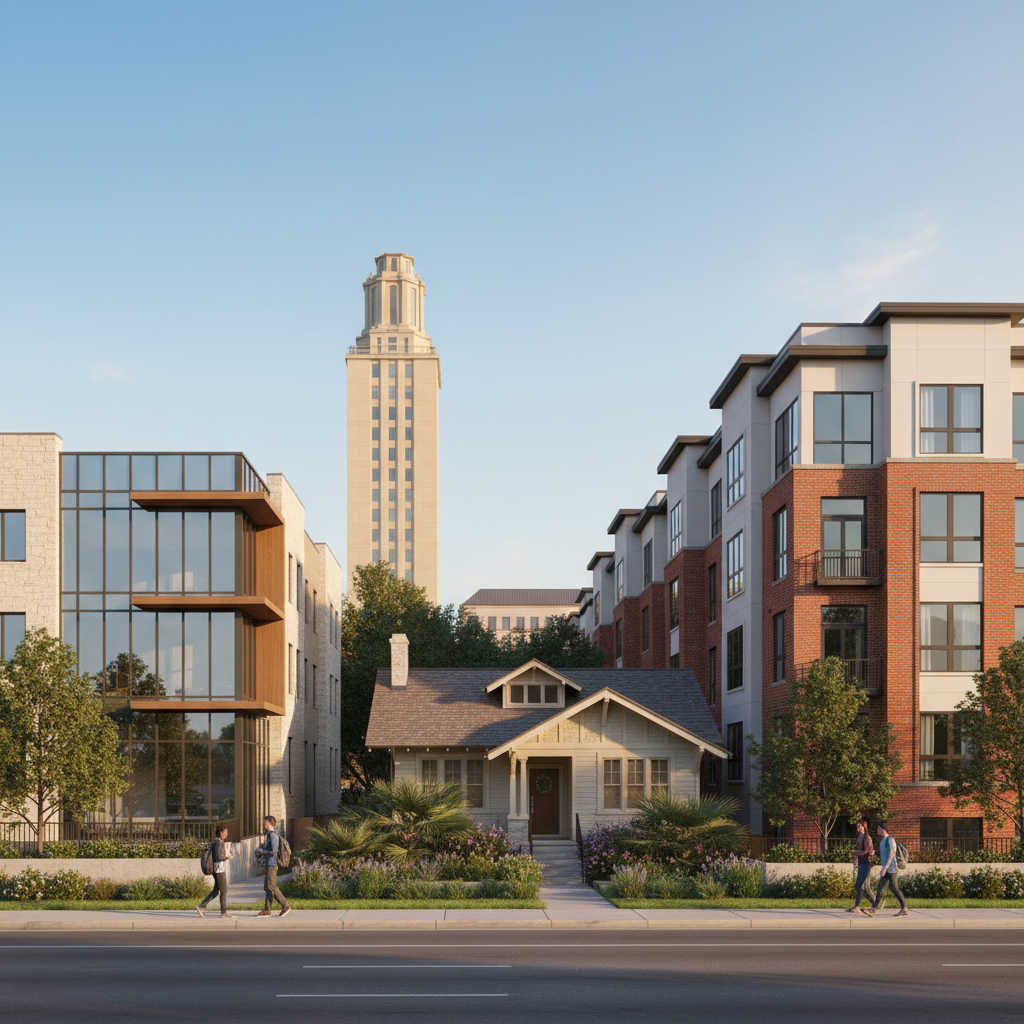
UT Austin investment properties are high-demand real estate assets located primarily in the West Campus, North University, and Hyde Park neighborhoods of Austin, Texas. These properties offer consistent rental yields driven by a permanent student population of over 50,000 and a restricted supply of walkable housing.
UT Austin investment properties refer to real estate assets, including student housing, condos, and multi-family units, purchased primarily for rental income and capital appreciation, specifically within the high-demand area surrounding the University of Texas at Austin.
Located minutes from the Texas State Capitol and the burgeoning Silicon Hills tech corridor, the UT Austin real estate market is anchored by iconic landmarks like the Darrell K Royal-Texas Memorial Stadium and the retail hub of 'The Drag' on Guadalupe Street.
The West Campus Advantage
West Campus is the densest residential district in Austin, characterized by high-rise student condos and historic subdivided homes. Investors prioritize this area for its 'Smart Housing' incentives and proximity to the University of Texas at Austin tower. With property values appreciating consistently, the local market sustains a vacancy rate significantly lower than the broader Austin MSA.
High-Yield Neighborhoods for Student Housing
Beyond West Campus, savvy investors target North University for its quieter atmosphere and Hyde Park for its historic charm and long-term equity growth. These micro-markets offer diverse asset types, from luxury condominiums on Rio Grande Street to multi-family duplexes near the Intramural Fields, catering to graduate students and young faculty.
Austin Real Estate Market Dynamics
Investing in Austin requires navigating a competitive landscape where cash offers and quick closing timelines are standard. Lisa Copeland Real Estate providing deep local data on pre-leasing cycles, typical price-per-square-foot for high-rises versus garden-style units, and detailed analysis of HOA fees which are critical for calculating net operating income.
The Lisa Copeland Investment Strategy
We specialize in identifying undervalued off-market opportunities and navigating the complex Austin zoning laws. Our approach focuses on data-backed acquisitions that prioritize cash-on-cash return and long-term capital appreciation in the 78705 and 78751 zip codes.
Navigating Austin's Zoning and Development Landscape
Investing successfully in UT Austin properties necessitates a nuanced understanding of local zoning ordinances and future development plans. Areas like West Campus fall under specific 'University Overlay' zoning, which influences density, height restrictions, and permissible uses. For instance, properties within the North University Neighborhood Plan area have different setback requirements and design guidelines compared to those in the central core. We monitor upcoming Capital Improvement Projects (CIPs) around The Drag and Guadalupe Street, identifying where infrastructure improvements could drive property value appreciation. Our team also specializes in interpreting CodeNEXT revisions and their potential impact on rebuild potential or ADU (Accessory Dwelling Unit) additions, key for maximizing rental income in areas like Hyde Park, which offers more flexibility for multi-unit conversions than more restrictive single-family zones.
Understanding Investment Property Financing in Austin
Securing favorable financing is crucial in Austin's competitive market. While conventional mortgages are common, many investors explore portfolio loans or hard money loans for quicker closings, especially for properties requiring significant renovation. Interest rates for investment properties in Austin typically range from 6.5% to 8.5% depending on credit score, down payment (often 20-25% minimum), and loan type. We connect investors with local lenders specializing in investment properties, who understand the nuances of student rental income projections. Property taxes in Travis County average around 1.8% of assessed value, a significant ongoing cost to factor into your proforma. Additionally, landlord insurance for rental properties, particularly those with higher occupancy or older structures, averages $1,500-$2,500 annually.
Avoiding Common Pitfalls in Student Housing Investment
Many new investors encounter avoidable issues in the UT Austin market. One common mistake is underestimating operating expenses, including maintenance, property taxes, and vacancy periods, leading to inaccurate ROI projections. Another pitfall is failing to understand the annual student turnover cycle, which significantly impacts lease-up strategies and advertising timing—missing the March-April pre-leasing window can result in extended vacancies. Inexperienced investors may also overlook the importance of robust lease agreements tailored for student tenants, failing to address issues like guarantor requirements, pet policies, or subletting clauses. We guide clients away from distressed properties with extensive hidden deferred maintenance or those in flood zones often overlooked by out-of-state buyers unfamiliar with Austin’s Lady Bird Lake watershed.
Evaluating Property Management for Your UT Rentals
Choosing the right property management firm can make or break your investment. Look for companies with specific experience in the UT Austin student housing market, as their operational demands differ significantly from traditional residential rentals. Key metrics to evaluate include their average vacancy rate for similar properties (ideally under 2%), their tenant screening process (including guarantor requirements), and their maintenance response times (critical for student satisfaction). Ask about their fee structure, which typically ranges from 8-12% of gross monthly rent, plus potential lease-up fees (often 50-100% of one month's rent). A reputable manager should also provide detailed monthly statements, handle rent collection, and ensure compliance with Austin's tenant protection ordinances, such as the Right to Cure policy.
Maximizing Returns Through Strategic Upgrades and Furnishing
To stand out in the competitive UT Austin rental market, strategic upgrades can significantly impact rent premiums and tenant retention. For instance, properties offering in-unit washer/dryer, updated kitchens with stainless steel appliances, and modern bathroom finishes consistently command 10-15% higher rents. Furnishing options, particularly for 2-4 bedroom units, are increasingly popular, appealing to international students or those seeking convenience. A typical furnishing package for a 3-bedroom unit, including beds, sofas, and dining sets, can cost $5,000-$10,000 but can shorten vacancy periods and justify a higher rental price point. Smart home technology, like smart thermostats and keyless entry, also adds appeal and perceived value, achieving a higher cap rate upon resale.
How it works
1Initial Consultation & Investment Goal Setting
2Targeted Property Search & Market Analysis
3Offer, Negotiation, & Due Diligence Support
4Closing & Post-Purchase Investor Resources
Why choose us
Specialized knowledge of UT Austin rental market data
Extensive network of local property managers and contractors
Proven track record of successful investor client outcomes
Frequently asked questions
What is the average ROI for UT Austin investment properties?
While ROI varies by asset class, investors typically see annual appreciation rates of 5-8% in the UT area, with gross rental yields ranging from 4% to 6% depending on the specific neighborhood and property management efficiency.
When is the best time to buy student housing in Austin?
The best time to acquire property is during the late fall or early winter. This allows investors to align with the peak pre-leasing season which begins in January for August move-ins.
What are the most popular housing types for UT students?
Students primarily seek two-to-four bedroom condos in West Campus with secure parking and high-speed internet. Graduate students often prefer detached ADUs or smaller apartment complexes in North University.
How do Austin's Smart Housing units affect investment?
The City of Austin provides density bonuses for developers who include affordable units. For investors, this ensures a diversified tenant base and often permits higher building heights in high-value zones.
Is professional property management necessary for UT rentals?
Given the high-turnover nature of student leasing and the specific legal requirements of the Austin Tenants' Council, professional management is highly recommended to maintain property condition and ensure continuous occupancy.
What are average property taxes for a typical investment property near UT?
Property taxes in Travis County, where UT Austin is located, average around 1.8% of the property's assessed value annually. For a $700,000 investment property, this would equate to roughly $12,600 per year, or $1,050 per month, which is a significant operating expense.
How does the annual student housing pre-leasing cycle work near UT?
The pre-leasing cycle for UT Austin student housing typically begins in October for leases starting the following August. The peak leasing activity occurs between January and April, when most prime units are secured. Missing this window can lead to higher vacancies or needing to offer rental concessions.
Can I convert a single-family home near UT into a multi-unit rental?
It depends on the specific zoning. In areas like Hyde Park or parts of North University with more flexible zoning, converting a single-family home into a duplex or adding an Accessory Dwelling Unit (ADU) may be possible, but West Campus zoning is generally more restrictive for new conversions.
What are the most effective ways to advertise UT Austin rental properties?
The most effective advertising channels include university housing portals, popular student-focused listing sites like Zillow and Apartments.com, social media groups for UT students, and local real estate websites. High-quality photos and virtual tours are essential to capture student attention.
Are there any specific tenant protection laws in Austin affecting landlords?
Yes, Austin has several tenant protection ordinances, including a 'Right to Cure' policy that gives tenants 10 days to correct a lease violation before eviction proceedings can begin. There are also specific rules around security deposits, move-out procedures, and notice requirements that landlords must adhere to.