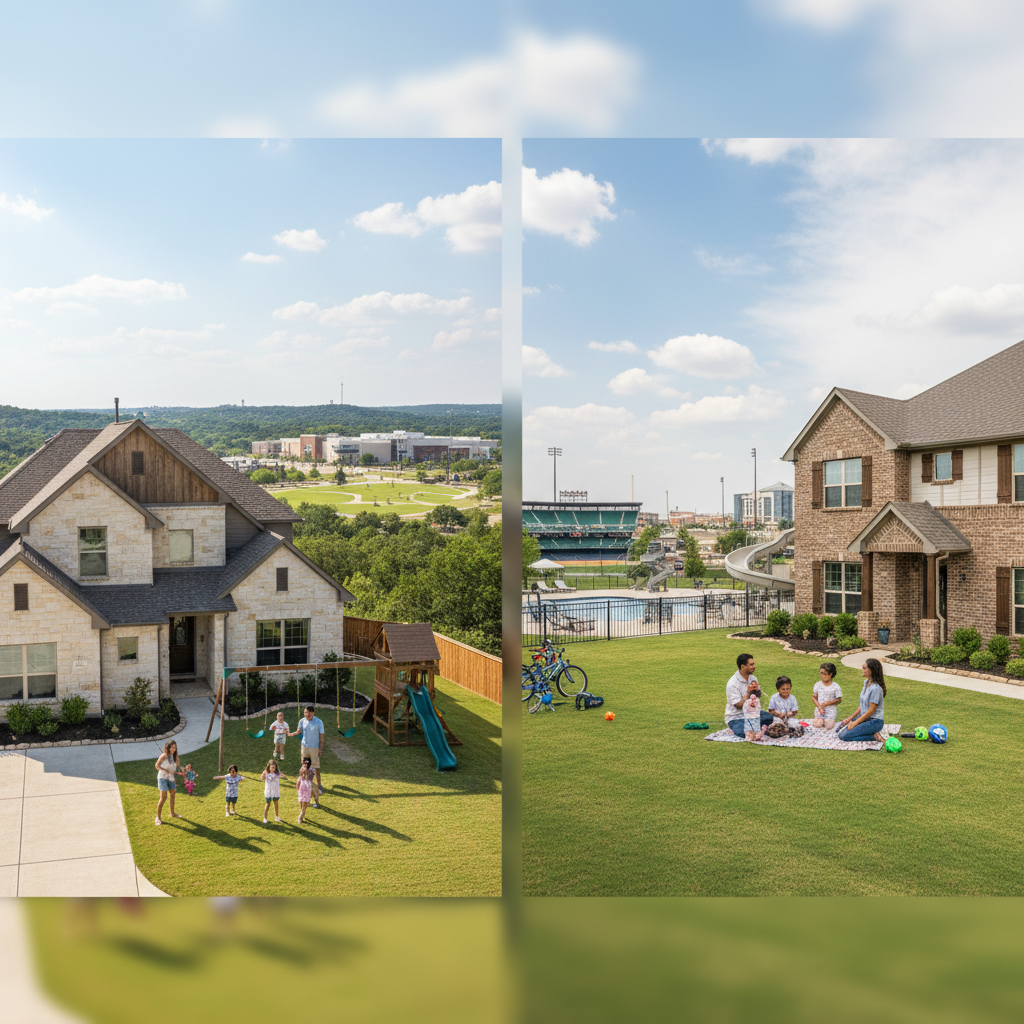
Cedar Park vs. Round Rock: Which Austin Suburb is Best for Families?
Choosing between Cedar Park and Round Rock is a common dilemma for families relocating to the Greater Austin area. Both cities offer exceptional safety, top-tier schools, and a high quality of life, but distinct lifestyle nuances set them apart. The Martinez Team at Horizon Realty is here to help you navigate which community aligns best with your family's unique goals.
The Martinez Team specializes in the Williamson and Travis County markets, offering hyper-local expertise on neighborhood pockets from the Avery Ranch border to the brushy hills of Whitestone Boulevard.
School Districts and Educational Excellence
For most families, the decision starts with Leander ISD in Cedar Park versus Round Rock ISD. Cedar Park schools are renowned for modern facilities and high academic rankings, while Round Rock ISD is one of the largest and most established districts in Texas, boasting several National Blue Ribbon schools. Both areas provide robust extracurricular programs, making them leaders in state-level athletics and arts.
Outdoor Recreation and Family Amenities
Cedar Park offers a slightly more hill-country feel with gems like Brushy Creek Lake Park and the H-E-B Center for professional hockey and concerts. Round Rock, known as the Sports Capital of Texas, features the massive Old Settlers Park and the Dell Diamond. If your family enjoys hiking and limestone landscapes, Cedar Park shines; if you prefer organized sports and massive water parks like Kalahari, Round Rock is hard to beat.
Real Estate Market and Housing Trends
Real estate in Cedar Park often features newer builds and master-planned communities like Twin Creeks and Ranch at Brushy Creek. Round Rock offers a diverse mix of established neighborhoods like Teravista and Forest Creek alongside new developments. Price points are comparable, though Cedar Park has seen slightly higher inventory premium lately due to its proximity to the growing North Austin tech corridor and Apple campus.
Commute Times and Employment Hubs
Both suburbs offer strategic advantages for tech professionals. Cedar Park provides easy access to Highway 183 and the 45 Toll, ideal for those working in the Domain or Northwest Austin. Round Rock sits directly on the I-35 corridor, making it a straighter shot to downtown Austin or north towards Georgetown. Your decision may ultimately hinge on whether you prefer the westward sprawl of the scenic hills or the central connectivity of the I-35 artery.
Healthcare Access and Quality of Life Services
When considering Cedar Park versus Round Rock for families, healthcare access and day-to-day services are crucial. Cedar Park benefits from proximity to Cedar Park Regional Medical Center, a 104-bed acute care hospital, and numerous specialized clinics on RM 1431 and Parmer Lane. Families often find a wide array of pediatricians, urgent care centers like Indigo Urgent Care, and dental practices close to residential areas like Bella Vista and Cypress Creek. Round Rock boasts a more extensive healthcare infrastructure with St. David's Round Rock Medical Center and Ascension Seton Williamson, both large full-service hospitals. The Scott & White Medical Center – Round Rock also offers specialized care, making Round Rock a hub for comprehensive medical needs. Both cities offer excellent public libraries, community centers, and youth programs, but Round Rock's larger population often translates to more diverse extracurricular options for children, from junior sports leagues to arts programs at places like the Kalahari Resorts & Conventions.
Community Vibe and Local Culture
The community vibe differs notably between Cedar Park and Round Rock. Cedar Park often feels like a more close-knit, suburban community, particularly in neighborhoods such as Forest Trails or The Preserve at Stone Oak. Its numerous local events, like the Cedar Park Farmers Market at Lakeline Mall or the annual Summer Nights Concert Series, foster a strong sense of local engagement. Families often connect through school functions and neighborhood parks. Round Rock, while larger, offers distinct community pockets. Areas like Old Town Round Rock maintain a historic charm, hosting events such as Music on Main and the Christmas Family Night. The city's larger scale allows for more diverse cultural experiences, from professional sports at Dell Diamond to various culinary festivals. Cedar Park maintains a quieter, slightly more upscale suburban feel, while Round Rock presents a bustling, diverse environment with a broader range of amenities and activities catering to varied interests, from tech professionals to long-time residents.
Cost of Living beyond Housing
While housing costs are a major factor, understanding other cost of living components is vital. Utilities, groceries, transportation, and childcare can vary. In Cedar Park, monthly utility bills (electricity, water, gas) for a 2,000 sq ft home average around $200-$300, slightly higher than Round Rock's average of $180-$280 due to different municipal utility structures. Grocery prices are comparable, though Round Rock has a broader selection of discount grocery stores like H-E-B Plus! and Sprouts. Transportation costs are often dictated by commute distance; Cedar Park residents commuting to Downtown Austin typically spend more on fuel and tolls ($10-$15/day on tolls) compared to Round Rock residents using I-35. Childcare costs are similarly high in both suburbs, averaging $1,000-$1,500 per month for infant care. Families in Cedar Park might find slightly fewer free community events, potentially leading to more paid entertainment options, whereas Round Rock's larger scale offers more no-cost public activities.
Public Safety and Emergency Services
Public safety is a paramount concern for families, and both Cedar Park and Round Rock maintain robust emergency services. The Cedar Park Police Department actively implements community policing programs, with police response times averaging 5-7 minutes for priority calls. The city's crime rate consistently ranks among the lowest in the Austin metro area, with violent crime rates significantly below national averages. Fire and EMS services are provided by the Cedar Park Fire Department, with multiple stations strategically placed to ensure rapid response across areas like Heritage Oak Park and Twin Creeks. Round Rock boasts a larger police force and fire department, commensurate with its larger population. Response times for the Round Rock Police Department are typically 6-8 minutes. While its overall crime rate is slightly higher than Cedar Park's, it remains well below national averages, particularly in residential zones. Both cities participate in regional emergency management initiatives, ensuring comprehensive disaster preparedness and swift, coordinated responses to any incidents, enhancing family security.
Future Growth and Infrastructure Development
Understanding future growth ensures long-term family stability. Cedar Park is experiencing significant commercial and residential development, particularly along the new Bell Boulevard redevelopment project, which will introduce mixed-use spaces and urban parks. The city's long-range plan includes expanding roadway capacity, particularly for RM 1431 and Brushy Creek Road, to accommodate an anticipated population increase of 20% by 2030. Round Rock, already a larger city, is focused on continued economic diversification. Current projects include the continued expansion of the Innovation Boulevard tech corridor and ongoing improvements to I-35 access roads, aimed at easing congestion. The city is also investing in its park system, with new features planned for Old Settlers Park. Both cities are proactive in managing growth through sophisticated zoning and master-planned communities. Cedar Park's development often integrates green spaces more intrinsically into new builds, while Round Rock’s larger scale allows for more expansive, multi-phase commercial and residential projects, indicating sustained opportunities for employment and family recreational activities.
Frequently asked questions
Which city has a lower cost of living, Cedar Park or Round Rock?
Both cities are very similar in cost, though property taxes can vary slightly depending on the specific municipal utility district (MUD) your home is located in.
Which suburb has better shopping and dining options?
Round Rock currently leads with the Premium Outlets and University Oaks, but Cedar Park is catching up quickly with the Lakeline area and new developments like Indigo Ridge.
How far are these suburbs from Downtown Austin?
Both are roughly 20 to 30 miles from downtown. Depending on traffic, the commute typically ranges from 35 to 55 minutes during peak hours.
Which area is safer for families?
Both Cedar Park and Round Rock consistently rank among the safest cities in Texas and the United States for their respective population sizes.
Are there new construction homes available in both cities?
Yes, while Round Rock has more infill development, Cedar Park and its neighbor Leander have significant new construction projects currently underway.
What specific events or festivals can families enjoy in Cedar Park?
Families in Cedar Park can enjoy events like the Fourth of July Celebration at Milburn Park with fireworks, the Cedar Park Market Days featuring local vendors, or holiday-themed events at Heritage Oak Park. The H-E-B Center also hosts numerous family-friendly concerts and shows throughout the year, especially for children.
Are there good options for higher education or vocational training nearby for families in Round Rock?
Yes, Round Rock is home to the Texas State University Round Rock Campus, offering various bachelor's and master's programs. Austin Community College (ACC) also has a large campus in Round Rock, providing vocational training and associate degrees, perfect for local families seeking continued education or skill development.
How do property taxes differ between Cedar Park and Round Rock for family homes?
Property tax rates can vary due to different taxing entities. Generally, Cedar Park's effective property tax rate, including Leander ISD, city, and county taxes, might be slightly lower than Round Rock's, which includes Round Rock ISD, city, and county. For a $400,000 home, annual taxes could range $8,500-$10,000 in Cedar Park versus $9,000-$10,500 in Round Rock.
What unique recreational facilities are available for children in Round Rock that Cedar Park might not have?
Round Rock boasts unique facilities like the Dell Diamond, home to the Round Rock Express baseball team, and the massive Kalahari Resorts & Conventions, featuring a huge indoor waterpark and family entertainment center. Old Settlers Park offers expanded sports fields and play areas beyond what Cedar Park typically provides for organized youth sports.
Which suburb offers better public transportation options for families without multiple cars?
Both Cedar Park and Round Rock are predominantly car-dependent. However, Capital Metro provides limited bus services in Cedar Park, connecting to some Austin routes. Round Rock's public transportation is also limited but includes some intracity routes and connections. Neither suburb currently offers extensive family-friendly public transit comparable to central Austin.